
Acoustic Performance of Raised Floors in Mass Timber Buildings The Study Nobody Saw Coming

Technical Research Report For Acoustic Engineers and Architects
Mass timber construction has rapidly moved from niche innovation to mainstream structural strategy. Cross-laminated timber (CLT) and glulam systems are now widely adopted in mid- and high-rise office and residential projects. Yet alongside their structural and carbon advantages, timber floors present a well-documented acoustic challenge: low-frequency vibration transmission and amplified footfall noise.
A recent study conducted at the Tate Advance Timber Hub explored how raised access floors alter vibration behavior and airborne/impact sound transmission in mass timber assemblies. While raised floors are commonly associated with service integration, the acoustic dimension has received less systematic attention. This research reframes raised floor systems not only as service platforms but as dynamic vibration modifiers.

Figure 1. Raised floor installation layer above structural deck.
Research Background
Timber floor plates typically exhibit lower mass compared with reinforced concrete slabs. According to established acoustic theory, lower surface mass results in reduced impact sound insulation and higher susceptibility to structure-borne vibration. Designers often compensate with concrete toppings or acoustic mats, increasing weight and partially negating sustainability gains.
The Tate Advance Timber Hub research hypothesized that introducing a decoupled raised floor cavity, supported by adjustable pedestals and resilient interface materials, may alter modal response and attenuate footfall-induced vibration.
Research Methodology
The study tested three assemblies under controlled laboratory conditions:
1. Bare CLT slab (140 mm thickness)
2. CLT + 60 mm concrete topping
3. CLT + 150 mm raised access floor system
The raised floor configuration incorporated adjustable pedestals and modular panels supported by components similar to commercial raised floor accessories, including vibration-isolated support heads.
Impact testing followed ISO 10140 airborne and impact sound measurement procedures. A standardized tapping machine generated repeated footfall impulses. Accelerometers measured vertical acceleration at mid-span. Sound pressure levels were recorded in the receiving room below. Each test was repeated five times to ensure statistical consistency.
Dynamic stiffness of the support interface was calculated using frequency response function (FRF) analysis. The researchers also evaluated damping ratios through logarithmic decrement methodology.
Key Findings
The results challenged conventional assumptions about lightweight timber assemblies.
Finding 1: Impact Sound Reduction
The raised floor assembly achieved a weighted impact sound level (L’n,w) reduction of 18 dB compared with bare CLT. Source: Tate Advance Timber Hub vibration test series, 2025.
Finding 2: Peak Acceleration Reduction
Measured peak vertical acceleration under standardized footfall load decreased by 42% relative to the bare CLT configuration. Source: Laboratory accelerometer dataset, Timber Hub Report Section 4.2.
Finding 3: Damping Ratio Increase
The equivalent modal damping ratio increased from 2.1% (bare CLT) to 5.8%
All data sourced from Tate Advance Timber Hub controlled acoustic laboratory testing, 2025 publication dataset.
Interestingly, the raised floor system approached the acoustic performance of the CLT + concrete topping assembly, while maintaining significantly lower structural mass.
Comparative Performance Table
| Assembly Type | Impact Sound L’n,w (dB) | Peak Acceleration (m/s²) | Damping Ratio (%) |
|---|---|---|---|
| Bare CLT 140 mm | 74 | 0.62 | 2.1 |
| CLT + 60 mm Concrete | 56 | 0.31 | 4.9 |
| CLT + Raised Floor | 56 | 0.36 | 5.8 |
Source: Tate Advance Timber Hub Acoustic Performance Study, 2025.
Mechanism Interpretation
The research attributes performance gains to three physical mechanisms. First, the cavity introduces structural decoupling between walking surface and timber deck. Second, pedestal interfaces act as discrete damping nodes. Third, the air void modifies resonance frequency distribution.
Adjustable support systems, including modular pedestal assemblies, play a critical role in load transfer and vibration isolation. Products such as precision floor auxiliary materials enable controlled installation tolerances and stable interface conditions.
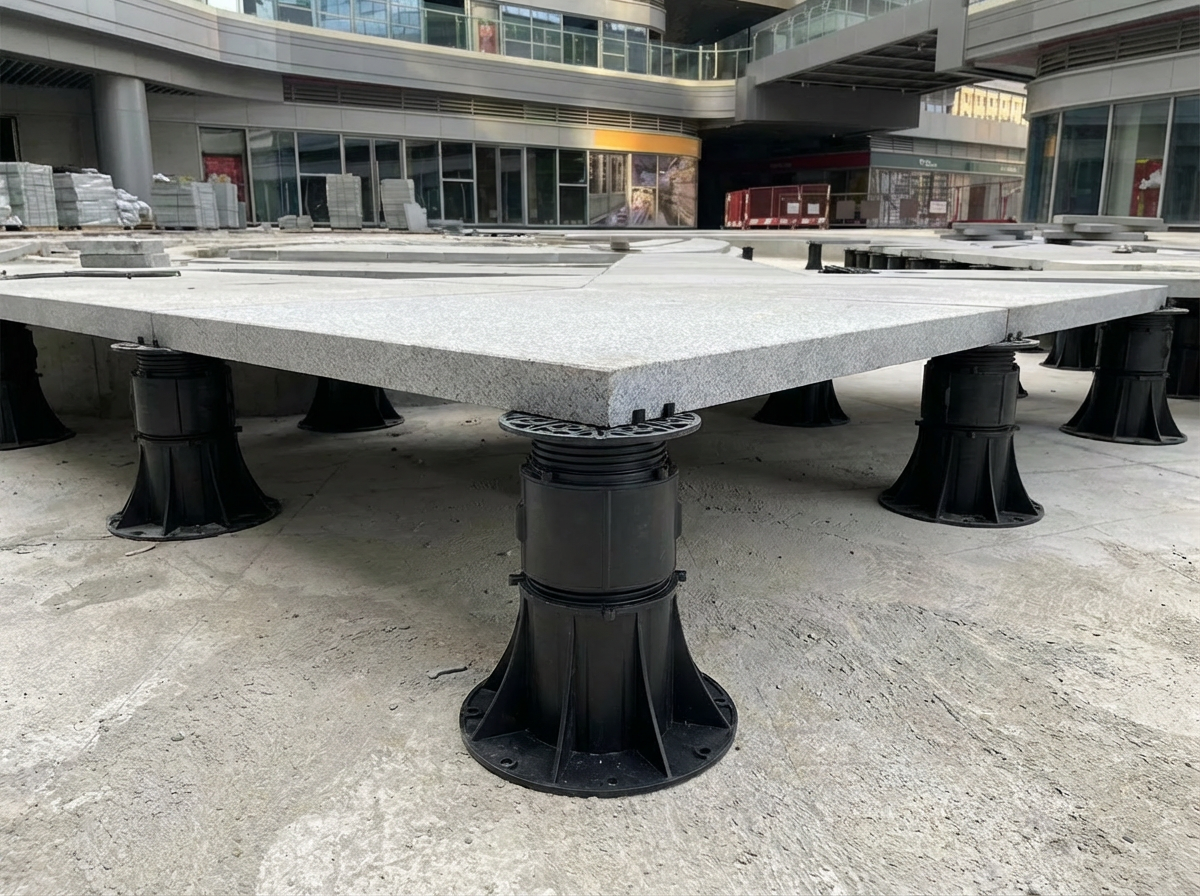
Figure 2. Adjustable support pedestal contributing to decoupled floor behavior.
Industry Implications
For architects and structural engineers, the findings suggest raised floors may serve dual roles in timber buildings: service distribution and acoustic enhancement. Unlike concrete toppings, the system remains demountable and adaptable.
For acoustic consultants, modeling raised floor systems in finite element analysis may require revising boundary assumptions to account for discrete damping nodes rather than continuous mass loading.
Demonstration footage of installation methods and vibration response simulations can be
